The
Legacy of Kansabati River Art and Architecture
River Kansabati has
been flowing from the unknown past of prehistoric times till today. Flowers,
fruits, grains and vegetables flourish across the fertile lands of the vast
riverbanks. The picturesque villages make Kansabati even more enchanting.
Kansabati has not only influenced the present civilization but has also
embodied the past civilization. Art architecture embedded in the womb of that civilization
flows from the dawn of civilization to today.
Kapisha to Kansabati
Kansabati is called
by various names including Karva, Kansbas, Kalindiganga, Kaliganga, Ganga, and
Kangshanadi. Before changing its course, the last part of the stream was called
Behula, Gangurya, and Gauri etc. However, the river known as Kapisha in the
long past history is known as Kansabati now.
Historical and Epic
Reference
There is no doubt
about the antiquity of the Kapisha or Kansabati River. Professor Paresh Chandra
Dasgupta, former Director
of Archaeology, West Bengal wrote in his book 'Subarnarekha Prangane
Aranyakanya Kansabati' that different phases of the Stone Age have passed in
the valley of the river Kansabati. In the light of successive discoveries, it
can be confirmed that the valley attracted the food-seeking 'hominids' in an
extensive chapter during the latter half of the Pleistocene period. Naturally,
the history of this river's contribution dates back to the earliest stages of
civilization in the distant past.
The Kapisha River is known from the epic
'Raghuvansam' by Mahakabi Kalidas, written between the 4th and 6th centuries
AD. Here the King Raghu triumphantly conquered Sumbhadesh (Tamralipta) and
other kingdoms in the east and crossed the 'elephant bridges' which were lined
up over the Kapisha River and marched towards Kalinga.
Again, it is known from the Madla Panji of
Utkal that King Anangabhimadev (reigned 1211-1238 AD) extended his kingdom up
to the Kansbas River (Kansabati) in the north.
The Kansai River is mentioned in the 16th
century poet Dwij Madhav's poem 'Chandimangal'. There Devi Chandi instructed
Vishwakarma to build a monastery on the banks of the 'Kangshanadi' or Kansai
River.
Nomenclature
The colour of the
water of the river flowing through the plateau is like ‘Kansa’ or brass. Hence
the name of the river is supposed to be Kansai. Later the river came to be
known as Kansabati and others.
Flow path
Jabar Hills in
Jhalda Block of Purulia District of West Bengal is the source of Kansai or
Kansabati River. It then flows through Purulia and Bankura districts of West
Bengal. At Bankura the Kansabati joins its main tributary the Kumari River. The
Kansabati dam is built at the confluence of the Kansabati and Kumari rivers in
Mukutmanipur. Then Kansabati entered Paschim Medinipur district. The river
splits into two branches at Kapastikari in Debra of Paschim Medinipur. Then the
main branch in the name of Kansabati flows through Purba Medinipur and joins into
the Keleghai River.
Extinct Behula River
and Kansabati
Once
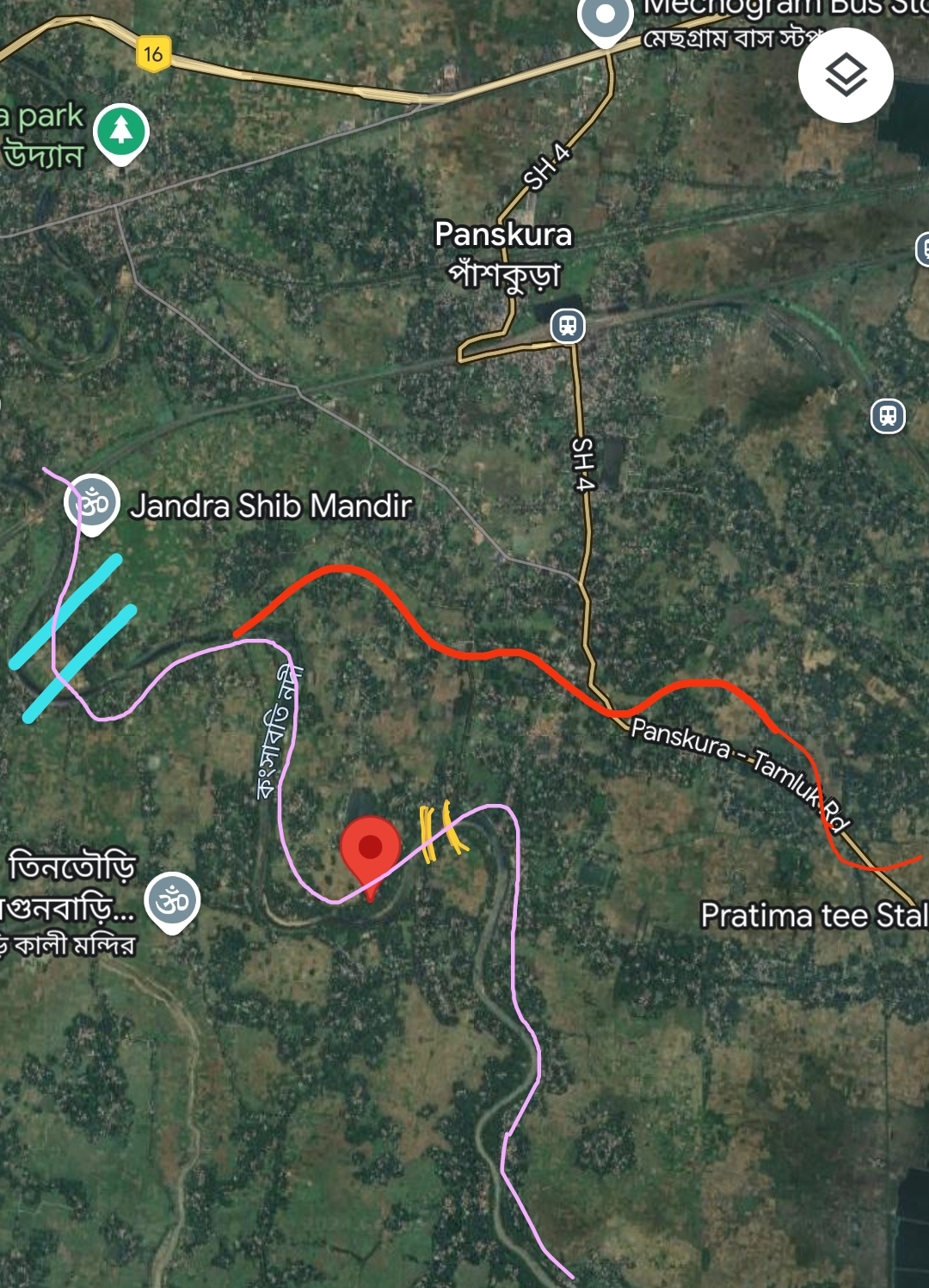
the lower reaches of the Kansabati was the extinct Behula River. The
Kansabati River changes its old course from Panskura of Purba Medinipur
district and now flows southwards. Kansabati River is actually a cut canal from
here. The previous flow of the lower reaches of the Kansabati from Panskura to
Rupnarayana River was known as Behula River. This river was also called Gauri
or Gangur or Gangura River. The river is now extinct.
Kansabati River in
the light of Archeology
Scattered
excavations in the vast river basin at various times
have yielded rich artefacts. Pre-medieval pottery, inscriptions, stone carvings
etc. have been found. Artefacts of Pala-Sena period, masts of large vessels, fragments
of boats recall the rich history of the region. Many artefacts like ancient
Vishnu idols, Buddha idols, Sanchistupa replicas, various handicrafts recall
the rich cultural heritage influenced by the river. Ancient terracotta temples,
the Garbari of the Kings and other ancient construction in the river basin are
the wonderful example of architecture influence by the river.
Development of
Buddhist Culture
The
extensive spread of Buddhist culture in Tamralipta is historically proved. We
know it from Hiuen Tsang, Fahien's description. Ancient Buddhist statues and
related artefacts are still found in the river basin. The development of
riverine Buddhist culture is acknowledged.
The legend
Once the lower
reaches of the Kansabati was the extinct Behula River. According
to folklore, the extinct Behula River is the 'Gangur River' as mentioned the epic
'Mansamangal'. Behula, the epic heroine was floating on a raft in the river 'Gangur'
with her husband who died in a snake bite. As per the geographical location of
the river, the culture of the surrounding peoples, folklore etc. the extinct
Behula river can be identified as the 'Gangur river' of 'Mansamangal'.
Historical
Background of the Flower Valley
Field after field
along the Kansabati Basin is a kingdom of flowers. There are so many collection
of flowers like Marigold, Chrysanthemum, Dopati, Rajni, Karan, Axter, Cherry,
Jhupsi, Bell, Rose, Gladiolus, Murgai etc. Hiuen Tsang was a
famous Chinese Buddhist, scholar, traveler and translator. He arrived in India
in 629 AD. He came to Tamralipti (Tamluk). It was the river basin of the then
Kansabati. According to his description, the land here is flat and watery. The
climate is warm. Flowers and fruits are plentiful. Due to the low-lying land
and abundant rainfall, the land here is naturally waterlogged most of the time.
All these areas were flooded with river water almost every year. As a result
the lands were very fertile as they were rich in silt. Therefore, there was
abundant production of flowers, fruits, vegetables and grains. About one and a
half thousand years ago, Hiuen Tsang saw such an abundance of flowers and
fruits when he arrived in the region. Naturally, the history of abundance of
flowers of the river basin is about one and a half thousand years old.
River influenced
Regional Folk Culture
From
the beginning of the 16th century, kirtan songs were widely practiced when Sri
Chaitanya Mahaprabhu passed through the Kansabati basin several times during
his journey to Nilachal. He imbued the region with Vaishnavism. Since then,
widespread kirtan music has become popular in the basin area.
Pot's songs of this region are basically
Kansabai based legend. Besides various mythological stories are depicted in
colors on cloth or paper canvas and sung. The artists depict the stories of
Ramayana, Krishna Leela, Manasamangal, Chandimangal etc. in the Pot-canvas.
Baul songs were created and spread around
the river Kansabati. Hence the Baul song of this region has a unique flavor.
Kabigan influenced by the Kansabati River
is usually performed in two groups. It is a kind of competitive song. The
leader of the party is called 'Kabiyal'. Kabial's companions are called
'Dohar'.
People of Tribal community perform dances
and songs with traditional musical instruments dressed in tribal genre.
Folk songs are one of the genres of music.
The daily life of the people, the happiness and sorrow, the struggle of life in
the Kansabati river basin emerge in this music. This song is mostly spread
orally in the society.
River influenced
Regional Handicraft
Kansabati
River has greatly influence the everyday life of the basin area. They made
various handicrafts for daily needs. Grass-leaf wrap, Pottery, clay idol, Metal
tools, fireworks, wooden furniture, materials of bamboo, regionalfoods like
‘gahana bori’, ‘alur chop’, ‘batasa’ etc. are the fine example of river
influenced handicraft.